



The Art of Mine Design: A Balancing Act Between Stable and Unstable Conditions
19 February, 2025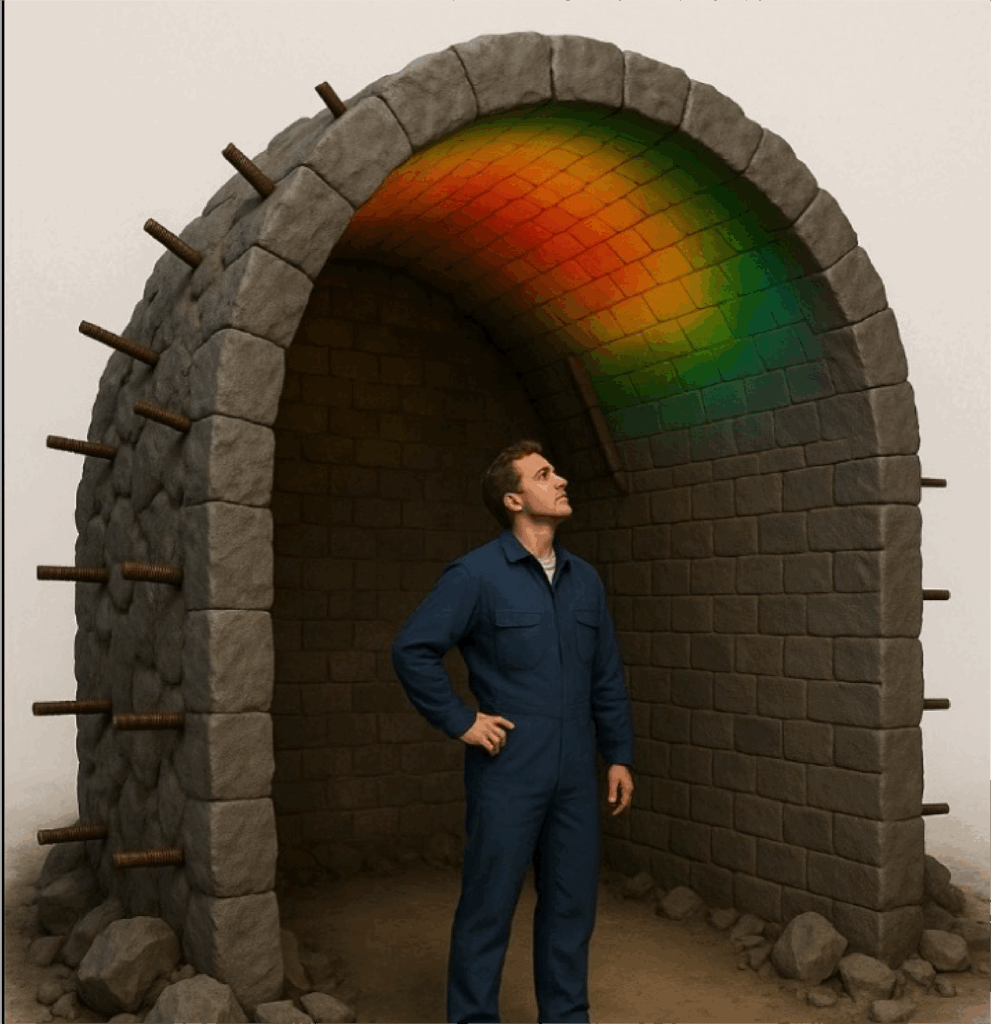
Rethinking Resin Bolts and Mobile Machine Damage
Underground safety is often judged by appearances. A bolt bent or severed by a Self-Propelled Mobile Machine (SPMM) is typically labelled as “damaged support” – a hazard demanding replacement. Inspectors halt production, crews rush to reinstall bolts, and work stops – all in the name of safety.
Beneath this routine lies a deeper question: does visible damage always mean functional failure?
This mismatch between visible damage and actual mechanical performance lies at the heart of what I call “the Functional Damage Paradox” – the idea that a support unit can appear broken yet continue to perform exactly as designed.
For decades, the industry has assumed that all damaged bolts must be replaced without definitive proof that these “damaged” bolts have truly lost their load-bearing capacity. My research at the University of the Witwatersrand set out to test that assumption and to quantify the real effects of SPMM impact on full-column resin-grouted bolts.
The Mechanics of Strength
To assess the problem, we must first understand how continuously mechanically coupled (CMC) bolts work. Unlike mechanical anchors that transfer load only at discrete points, a full-column resin-grouted bolt is bonded to the rock along its entire length through a thin resin annulus. This continuous bond creates a stiff, composite system in which any rock movement mobilises resistance along the bolt–resin–rock interface.
When the rock mass deforms, movement is transferred to the bolt through shear and axial stresses that develop along these interfaces. The ribbed profile of the bolt interlocks mechanically with the resin, while the rough borehole wall provides similar interlock between the resin and the rock.
Load transfer is not uniform: shear stress is highest near the point of movement and decays exponentially with distance into the rock. Laboratory tests show that the peak shear strength concentrates within 100 to 150 mm of bonded length, beyond which stresses dissipate rapidly. Because of this behaviour, a debonded section near the collar does not necessarily compromise the bolt’s overall anchorage since most of the resisting load is quickly redistributed to the intact portion of the resin column.
Testing the Paradox
To replicate underground conditions, I installed resin-grouted bolts in steel pipes set into rock and allowed the resin to cure. Then, the bolts were deliberately struck by an SPMM to mimic a real side-swipe impact. Afterward, each bolt was cut into short segments and tested for bond strength.
The results revealed that when the annulus was 4.5 mm or less, resin damage from the impact did not extend beyond 100 mm, or roughly four times the bolt’s diameter, from the point of contact. The remainder of the bolt remained intact, with bond strength nearly identical to undamaged control samples.
In contrast, when the annulus exceeded 4.5 mm, the resin quality deteriorated up to 400 mm from the impact. Interestingly, even undamaged samples showed weak bonding within 400 mm of the collar, proving that poor installation can be more detrimental than mechanical damage.
Challenging Assumptions
These findings suggest that the blanket replacement of every damaged bolt may be unnecessary, particularly when installation quality and annulus control are maintained. If a bolt has a small, well-mixed annulus, collision damage is limited to its exposed section and does not compromise its load-bearing capacity.
This challenges the current conservative approach and points to a more evidence-based, risk-informed standard for maintenance and inspection. Instead of relying solely on what we can see, we should evaluate what we can measure. Mines could evaluate damage relative to installation parameters, saving time, cost, and unnecessary labour while maintaining safety integrity.
The Broader Implications
The study also revealed a broader truth: the real threat lies not in SPMM impacts but rather in poor installation practices and poorly designed systems. Across several sites, bolts that looked perfect on the outside were found to be poorly spun or incompletely mixed, leaving voids in the resin column. In other words, “perfect” bolts were sometimes the weakest of all. This problem was significantly worse when installations were conducted using hand-held percussive drills with airlegs.
Quality installation, training, and equipment matching are the real foundations of safe ground control. We can replace bolts endlessly, or we can fix the process that makes them weak in the first place.
Looking Forward
The conclusion is simple: A damaged bolt is not necessarily a failed bolt.
When designed, installed, and grouted properly, a full-column resin bolt is remarkably resilient. Understanding the true extent of impact damage allows mines to optimise maintenance strategies, focus resources where they matter most, and continue operating safely and efficiently.
The next step is to translate this understanding into practical, site-specific standards that guide replacement decisions by data rather than habit. Because in the end, the strength of any support system lies not just in the steel or resin, but in the knowledge and discipline behind every bolt.
André Esterhuizen, October 2025