

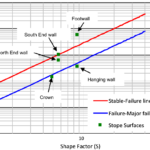
Consider this, when using Stability graphs for open stope design
20 August, 2024
Uncalibrated numerical models: as useless as a parachute that only opens in theory
29 November, 2024

“EVERYTHING SHOULD BE made as simple as possible, but not simpler.” To augment our understanding of rockmass responses, engineers create simplifications of reality using physical, mathematical, empirical or numerical models. Some engineers indulge in creating models of high detail and many input parameters, closely resembling a Picasso version of the rockmass. Often those inputs are not justified or validated. Hence, the value addition of the detailed, arty models becomes questionable. Despite all the effort towards the detail, models and engineers cannot process all the variables that characterize rockmass behaviour without falling victim to biases or fallacies, such as the confirmation or narrative biases or cognitive dissonance.
Confirmation bias : “We have not seen any ribs failing; hence, we don’t require sanity checks on pillar designs. We should focus on seismicity on structures”.
Narrative bias: “Since before I came here, empirical models were sufficient to assess stability of excavations. I was told, numerical models are useless here.”
Cognitive dissonance: Plastic models are used to simulate damage, while at this particular mine, the engineer knows that the most important input namely, pre-mining stresses have not been measured at any stage.
Numerical models make great partnerships with engineers as they help us turning rockmass responses into meaningful information and assist making the connection between data and designs. Models are neither AI nor machine learning. They don’t have engineering judgement, understanding and logic we have. It’s our job to make the connection between data and the model and beware of biases.
Gerrit Kotze, 30 October 2024